
No. 1 · October 2026
Early years · Play & curriculum
The Maths Was Already on the Board
Why traditional games belong in the kindergarten, and why we should stop calling them heritage.
A Pallankuzhi board has fourteen pits and no written instructions.
In a kindergarten I worked with, two children sat on the floor on either side of a wooden board with a heap of tamarind seeds between them. One lifted the seeds from a single pit and began to sow them, one into each pit along the row, counting under her breath. When the seeds ran out sooner than she expected, she stopped, went back and counted again.
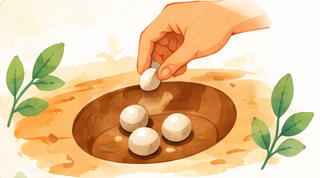
Across the board, her partner was not counting at all. He was watching which pit she would empty next and quietly moving his hand towards the one he meant to capture.
Neither child had been told that this was a mathematics lesson. Neither needed to be.
I have worked in early childhood education for more than fifteen years, in Waldorf, International Baccalaureate and play-based settings. Scenes like this one are common. It is uncommon for us to treat them as curriculum.
What the game asks of a child
- 1One-to-one correspondenceOne seed, one pit.
- 2Counting onKeeping track across a row of pits.
- 3PredictionIf I lift this pit, where will my last seed fall?
- 4StrategyWhich move leaves my opponent the least?
- 5Social learningNo worksheet provides this. The child must wait for a turn, accept a loss and agree to play again.
Other boards add their own demands.
Aadu Puligoats and tigers
A child must see the board from the other player's side and anticipate a tiger's move before it is made.
Paramapadhamour own snakes and ladders
Virtues sit on its ladders and vices on its snakes, so each climb and each fall becomes an occasion to talk about conduct.
The boards already hold counting, strategy and ethics.
Hands first, then words, then symbols
This matters because of the order in which young children learn. A child meets an idea with her hands first, then learns the word for it, and only then is ready for the abstraction.
A child who has sown seeds around a board many times has a physical knowledge of counting on. When the numeral and the number line arrive, they have something to attach to. Begin with the symbol instead, and the learning tends to stay shallow.
So why are the games missing?
Equipment is not the reason. Most schools already own a board, or could make one from an egg tray. What schools lack is teacher time, permission to spend that time on play, and the language to explain to parents and managements what the play is doing.
The National Education Policy 2020 has, in principle, granted that permission through its emphasis on play-based and activity-based learning in the foundational years. Finding the language is harder, and educators can help one another with it.
Curriculum that happens to be old
We tend to speak of these games as heritage, something to preserve, display at a festival and remember fondly. I would propose a different framing.
They are not heritage that happens to contain some learning. They are curriculum that happens to be old.
Generations of players designed and refined them long before any of us wrote a lesson plan, and they have lasted because they work.
Treating them as curriculum changes what we ask of them. A teacher would observe a round of Pallankuzhi with the same care she gives a reading assessment. She would note which child counts on and which starts again from one, and plan the next step from there. The board would sit on the mathematics shelf, not in the cultural corner.
Try this week
If you teach young children or are raising one, take a board down this week and play a full game together.Then watch what the child's hands already know.
Free from Sarvam Ekam
We have published these to help educators find the language for play. Puppetry belongs here for the same reason the games do: it teaches sequence, voice and attention, and it has stayed at the edge of the classroom for too long.
- Play PallankuzhiThe 14-pit counting game, in the browser.sarvamekam.in/pallankuzhi
- Play Aadu PuliGoats and tigers, for two players.sarvamekam.in/aadu-puli
- Play ParamapadhamSnakes and ladders with virtues and vices.sarvamekam.in/paramapadham
- Games by age, 0 to 21A framework mapping traditional games to each stage.sarvamekam.in/traditional-games
- Indian puppetryNew: 13 picture books on puppet traditions.sarvamekam.in/indian-puppetry
- Indian art forms16 picture books, from a map of India.sarvamekam.in/indian-art-forms