Four Children, One Rainy Morning: The Four Temperaments in a Chennai Classroom
A Chennai teacher sees the four temperaments in children one rainy morning. What this old Waldorf lens teaches about seating, pacing and form drawing.
 Jayanthi Vijayan
· 6 min read
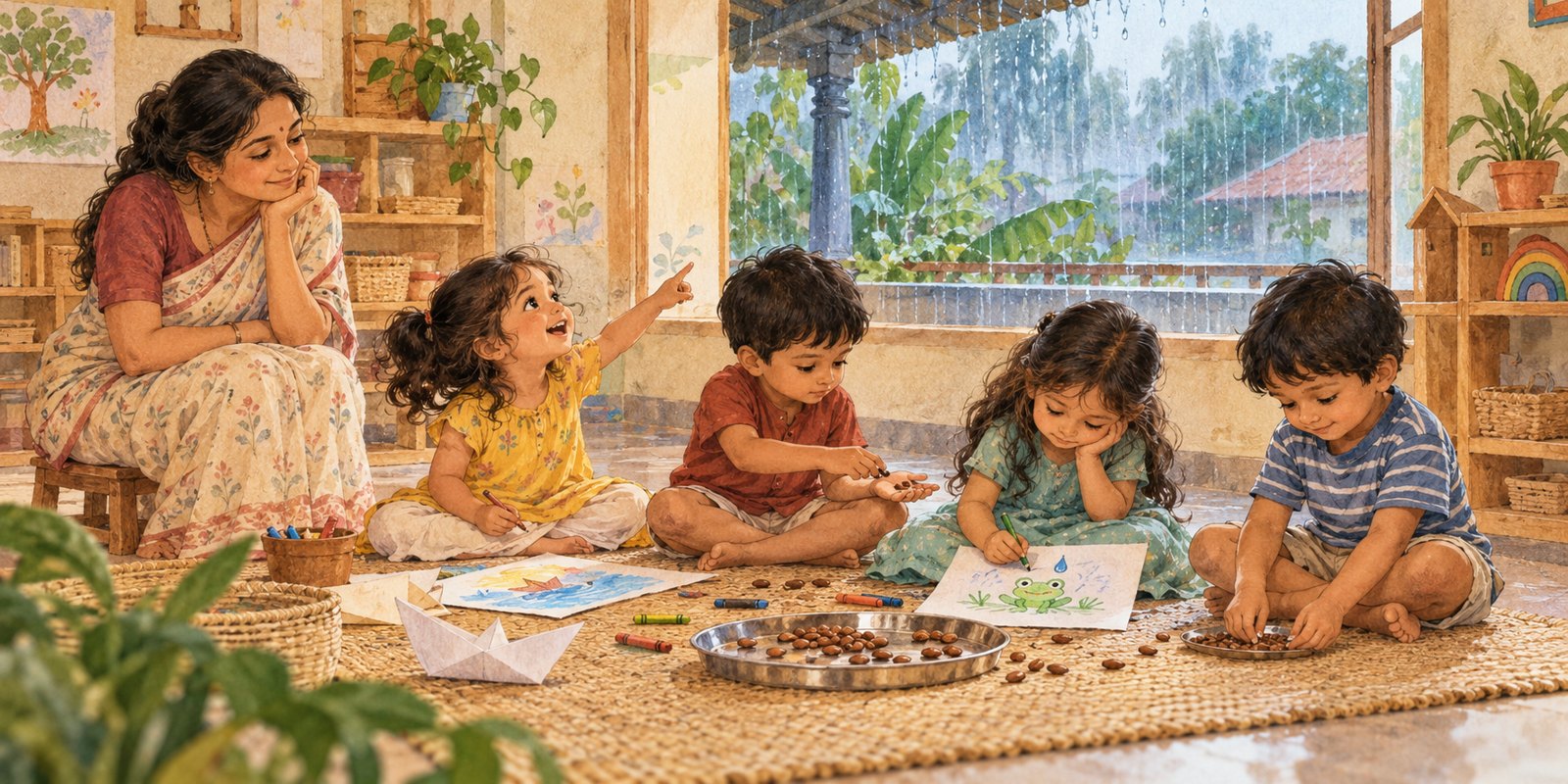
I have been thinking about the four temperaments in children ever since a rainy morning in Chennai earlier this month. The northeast monsoon had arrived properly. Water was running off the verandah roof in a thin silver curtain, and the classroom smelled of wet slippers and coconut oil.
I was sitting on a low stool at the back, the way I like to. The teacher, whom I will call Kavitha, had done our training a year ago. She did not know I would spend most of that morning watching her watch her children. By the end, she was smiling in a way I have rarely seen a teacher smile at eleven in the morning.
Four children, one rainy morning
The plan was simple. Tamarind seeds in a steel plate, a story about a little frog looking for a dry home, and some crayon work. But the rain had other plans, and the children showed us exactly who they were.
The child at the window
Aditi was up before the story had even begun. "Miss, a frog! Miss, the water is making a river! Miss, can we make paper boats?" She started counting seeds, left them to look at the drain, came back, and started on a drawing. Three beginnings in five minutes. Bright, warm, and everywhere at once.
The child who took charge
Karthik had already decided the seeds must be shared out properly. He was going round the mat, giving each friend exactly ten and telling them where to sit. When someone took eleven, his face went red. He was not being naughty. He simply needed the world to be in order, and he wanted to be the one putting it in order.
The child who felt everything
Nila sat near the wall, holding the paper boat she had brought from home. One corner had got wet in the auto. She was quiet for a long time. Later, when she drew the frog, she gave it tiny toes, a raindrop on its head, and a sad little mouth. She remembered every word of the story. She also remembered that the frog had been lonely.
The child who was simply content
And then there was Imran. He opened his tiffin box early, slowly ate his idli, and watched everyone else with mild, friendly interest. He did not rush. When it was time to pack up, he was the last to finish, and also the only one who put every single seed back in the plate.
Kavitha turned to me and whispered, "Akka, I could watch them all day."
What Waldorf means by the four temperaments
What Kavitha had seen, without naming it, is an idea Waldorf teachers have used for a hundred years. It comes from a very old picture of human nature, going back to the Greeks, which Rudolf Steiner brought into his teaching.
The four temperaments are:
- Sanguine – light, curious, sociable, quick to start and quick to move on. Like air. That was Aditi.
- Choleric – strong-willed, energetic, a born leader, quick to anger and quick to act. Like fire. That was Karthik.
- Melancholic – sensitive, thoughtful, deep feeling, drawn to detail and to sorrow. Like earth. That was Nila.
- Phlegmatic – calm, steady, comfortable, loyal, slow to begin and slow to stop. Like water. That was Imran.
A lens, not a label
I must say this clearly, because I have seen good ideas turn into rubber stamps. The temperaments are not a diagnosis, and they are not a modern scientific test. They are a lens for looking. Most children are a mix of two or more. A temperament also shows up differently on a rainy day, a hungry day, or the day a new baby arrives at home.
So we never write "melancholic" on a child's report card. We never say to a parent, "Your son is choleric." We use the picture quietly, inside ourselves, to help us meet the child more kindly.
A child is not a problem to be fixed. A child is a weather to be understood, and every weather has its own beauty.
How teachers use it: seating, pacing and form drawing
Seating
In many Waldorf classrooms, teachers seat children of a similar temperament near each other. It sounds strange at first. But put two Karthiks together and they rub off each other's sharp corners. Two Adities chatter, and then get a little tired of each other. The quiet Nilas feel less alone. The Imrans are not left behind by the faster children.
Pacing
A good morning breathes in and out. A lively song, then a quiet story. Clapping rhymes, then sorting seeds in silence. The sanguine child needs the change. The phlegmatic child needs the steady rhythm. The choleric child needs something to do with their body. The melancholic child needs a moment to feel. One well-paced morning holds all four.
Form drawing
Form drawing is the practice of drawing flowing lines, curves and patterns, slowly and with care, much like a kolam. Teachers sometimes choose forms with the temperaments in mind:
- Strong, clear forms with firm turns for the choleric child, who loves effort.
- Forms that must be finished with care and attention for the sanguine child.
- Open, flowing forms that move outward for the melancholic child.
- Rhythmic, repeating forms with small surprises for the phlegmatic child.
Our own kolam tradition already knows this. Watch how different children join the same dots on a festival morning, and you will see four temperaments on one doorstep.
Why observing is itself the joy
Here is what moved me most. Kavitha did nothing dramatic that morning. She did not shout or bribe. She gave Karthik the job of seed-keeper. She let Aditi make one paper boat, and only one. She sat beside Nila and said, "The frog was lonely, no? But look, he found a friend." She gave Imran an extra minute.
Every one of those small choices came from watching first. I have written before about why I ask teachers to observe for ten minutes before they teach. The temperaments give that watching some shape.
Many teachers tell me they are tired. Often the tiredness comes from fighting the children's natures instead of reading them. When a teacher starts to see the four temperaments in children, the classroom stops feeling like noise. It starts to feel like music, with four instruments.
That is why Kavitha was smiling. She was not managing the class. She was enjoying them.
Try this in your classroom this week
You do not need a Waldorf school to begin. You need a notebook and a little patience.
- Watch one free-play time without stepping in. Note who starts, who leads, who notices, who waits.
- Write one line about each child, in plain words, not labels. "Loves to be first." "Remembers sad parts of stories."
- Change one seat and see what happens over a week.
- Plan one morning that breathes: lively, then quiet, then lively again.
- Play an old game like Pallankuzhi or Aadu Puli and watch how each child plays. Our traditional games by age page is a good place to start.
If you want to go deeper, our KG teacher training brings together Waldorf, Montessori and Reggio Emilia, with plenty of time for this kind of observing. Sarvam Ekam works with a group of schools and trains teachers on their own campuses.
Write to me through our contact page. Tell me about the four children in your class. I would love to hear about them.
With warmth, Jayanthi
Questions parents and teachers ask
What are the four temperaments in children?
They are sanguine (lively and curious), choleric (strong-willed and energetic), melancholic (sensitive and thoughtful) and phlegmatic (calm and steady). Waldorf teachers use this old picture of human nature to understand how each child meets the world.
Is the four temperaments theory scientific?
No, it is not a modern scientific test or a diagnosis. In Waldorf education it is a lens for observing children more kindly, and most children are a mix of temperaments.
How do Waldorf teachers use the temperaments in class?
They may seat children of similar temperament together, plan lessons that move between lively and quiet activities, and choose form drawing patterns that suit each child. Mostly, it helps them respond to a child instead of reacting.
Should I tell parents their child's temperament?
It is better not to label a child to parents or on a report. Share what you observe in plain words, such as 'she notices small details', and keep the temperament picture as a private guide for your own teaching.
More Letters from the Founder →
Jayanthi Vijayan
Founder of Sarvam Ekam. Jayanthi works with kindergartens across India on audits, teacher training and curriculum design, bringing together Waldorf, Montessori, Reggio Emilia and traditional Indian play.
Connect on LinkedIn →