Why I Ask Teachers to Observe for Ten Minutes Before They Teach
Why observing children in kindergarten for ten minutes before teaching changes everything, and a simple daily routine any Indian KG teacher can start tomorrow.
 Jayanthi Vijayan
· 6 min read
When I visit a school, the first thing I ask is something small: before you begin your lesson, spend ten minutes observing children in kindergarten the way you would watch a garden in the morning. No talking, no teaching, no correcting. Just watching.
Most teachers smile politely and look at the clock. There is a syllabus to finish. There are worksheets to send home. Ten minutes feels like a lot to give away. So let me tell you why I keep asking, and why I think it may be the most useful ten minutes of the school day.
The morning the flashcards waited
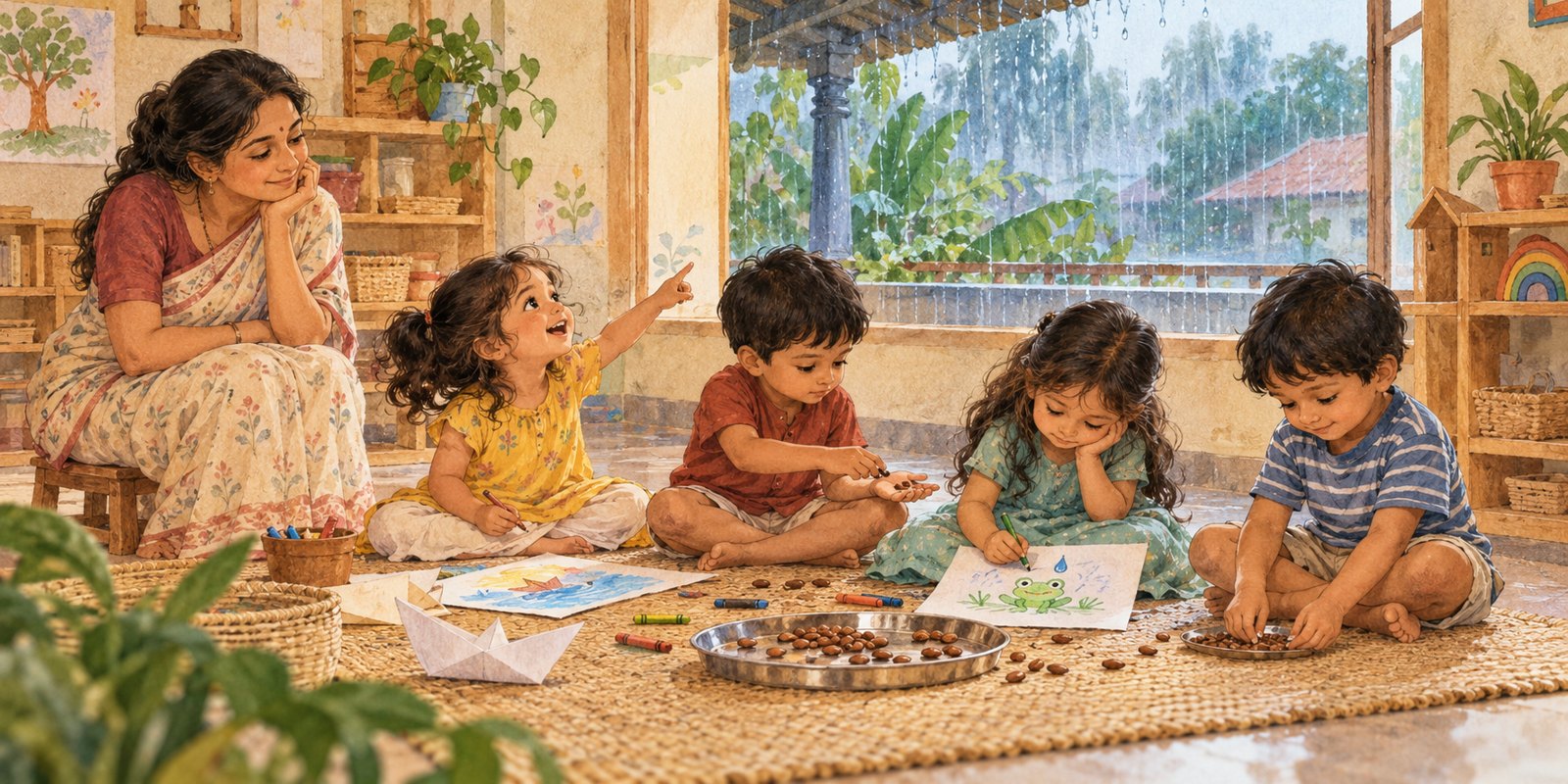
Some time ago I sat in a KG classroom in a small town in Tamil Nadu. The teacher was young, sincere and very well prepared. She had a neat stack of flashcards for the number five, a chart and a song ready. The children were still coming in, steel tiffin boxes clinking, chappals being lined up at the verandah.
I asked her to wait. Ten minutes, I said. Just sit on the low bench and watch.
This is what she saw.
A boy had found a handful of tamarind seeds in his pocket. He was lining them up along the crack in the floor, one by one, counting under his breath in Tamil. When he reached five he stopped, looked at them, pushed one away and counted again.
Two girls had opened their tiffin lids and were "cooking" with them, serving each other imaginary idlis. One was firmly in charge. The other waited for her turn, and when it did not come, she quietly went and sat alone.
And by the window, a little girl was holding the side of her head. She was not being naughty or dreamy. She had an earache, and she had not told anyone.
When the ten minutes were over, the teacher turned to me and said, "The boy already knows five. And I would have scolded that girl for not listening."
The flashcards stayed on the table that day.
What ten minutes shows you
Children tell us everything, but rarely in words. They tell us with their hands, their bodies, the corner they choose, the friend they look for, the toy they keep going back to.
When we walk in and start teaching straight away, we teach the lesson we planned. When we observe first, we can teach the children who are actually in front of us.
In ten quiet minutes, you will begin to notice:
- Who comes in happy, and who comes in carrying something heavy from home
- What a child already knows, without being tested
- Which friendships are forming, and who is being left out
- Who needs to move, who needs to be quiet, who needs to be held
- What the children are curious about this week, which may not be in your plan at all
I have come to believe that a teacher who watches well will always teach better than a teacher who only plans well.
Why this is not wasted time
I understand the worry. The day is short, and the pressure from parents and management is real. But observation is not a pause in teaching. It is where good teaching begins.
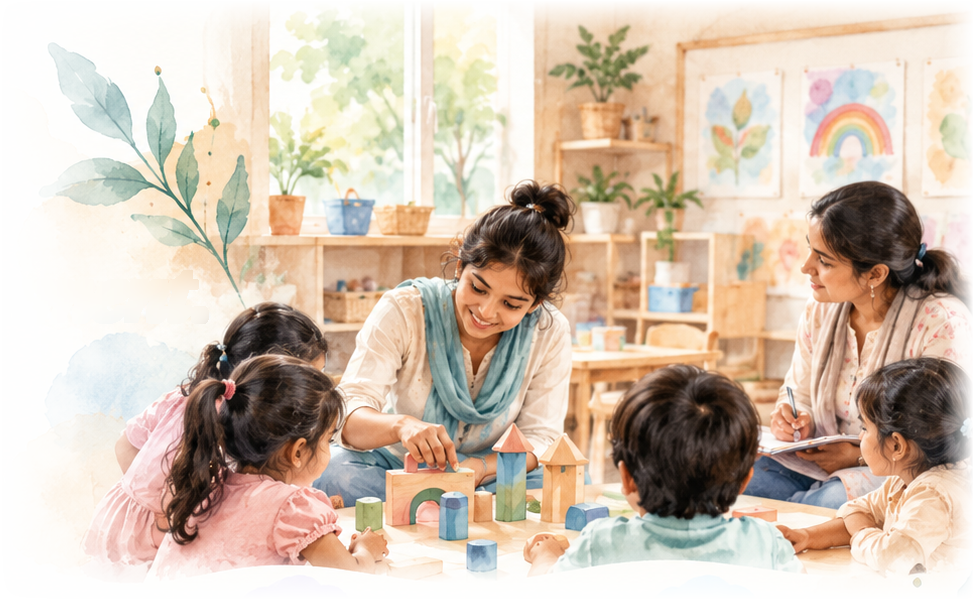
All three traditions we draw on in our KG teacher training put watching the child at the centre. Montessori teachers are trained to step back and observe before they present a material. Reggio Emilia educators study what children do and say, and let that shape what happens next. Waldorf kindergartens hold a gentle daily rhythm in which the teacher watches each child with real warmth. They differ in many ways, but they agree on this.
Closer home, NEP 2020 and the NCF for the Foundational Stage (NCF-FS) 2022 both speak of understanding each child, of play and of assessment that is ongoing and observation-based rather than only tests and worksheets. Ten minutes of watching every morning is a simple, honest way to begin doing what our own national documents are asking of us.
How to begin: a simple way to observe
You do not need a special format or an app. You need a notebook, a pencil and a little patience.
Where to sit
Sit low, at the children's height, a little to one side. If you stand in front of the class like a teacher, the children will behave like students. If you sit quietly at the edge, they will simply be children.
What to write
Write only what you see and hear, not what you think it means. Not "Karthik is lazy," but "Karthik sat near the door, did not open his bag, watched the others." Not "Meena is clever," but "Meena sorted the blocks by colour, then by size, without being asked."
The meaning will come later. First, the seeing.
What to watch for
Pick just one or two things each day. On Monday, watch hands: who grips the crayon well, who struggles with buttons. On Tuesday, watch friendships. On Wednesday, watch language: which words, which language, how much. You will be surprised at how much you have been missing.
What not to do
- Do not interrupt to correct or praise
- Do not ask the children to "show" you anything
- Do not turn it into a test
- Do not worry if nothing seems to happen. Something always does.
What changes after a few weeks
Teachers who try this for a month tell me the same few things.
They shout less, because they have understood why a child is restless. They plan differently, because they now know the boy with the tamarind seeds is ready for more than five, and the girl by the window needs a word with her mother. Their parent meetings become richer, because they have real stories to share instead of only marks.
Most of all, they say they feel closer to the children. That is the heart of it. The future begins with truly connecting with the child, and you cannot connect with someone you have not taken the time to see.
If you would like to bring this into everyday play, our letter on play-based learning in kindergarten has ideas that fit very naturally with a morning of quiet watching.
For parents and school leaders
Parents, you can do this at home too. Before you ask "What did you learn today?", sit for a few minutes while your child plays with vessels in the kitchen, or with pebbles in the yard. You will learn more than any answer can tell you.
School leaders, please protect these ten minutes. Do not fill them with announcements or assembly practice. When Sarvam Ekam does a Kindergarten Audit, one of the things we look for is whether teachers have the time and space to really see the children. It is one of the clearest signs of a healthy classroom.
Begin tomorrow morning
Tomorrow, when the children come in, keep your lesson on the table for ten minutes. Sit low. Keep your notebook open. Watch one child, then another. Write down what you see.
Do it for two weeks, and then tell me what you noticed. I would truly love to hear.
If your school would like help building observation into teacher training and daily routines, Sarvam Ekam works with a group of schools and trains teachers on their own campuses. You can write to us here.
With warmth, Jayanthi
Questions parents and teachers ask
Why should kindergarten teachers observe children before teaching?
Observing first shows the teacher what children already know, how they are feeling and what they are curious about. The lesson can then fit the real children in the room, not only the plan on paper.
How long should a teacher observe children each day?
Ten quiet minutes at the start of the day is enough to begin. Doing it regularly matters more than doing it for a long time.
What should I write down when observing a child?
Write only what you see and hear, such as what the child did, said or chose, and leave out labels like 'lazy' or 'clever'. Focus on one or two things each day, such as hands, friendships or language.
Does NEP 2020 support observation-based assessment in early years?
Yes. In general terms, NEP 2020 and NCF-FS 2022 encourage ongoing, observation-based assessment and understanding each child in the foundational years, rather than relying only on tests and worksheets.
More Letters from the Founder →
Jayanthi Vijayan
Founder of Sarvam Ekam. Jayanthi works with kindergartens across India on audits, teacher training and curriculum design, bringing together Waldorf, Montessori, Reggio Emilia and traditional Indian play.
Connect on LinkedIn →