Every Kindergarten Needs a Mud Kitchen
A mud kitchen for kindergarten costs almost nothing and teaches maths, language and friendship. Here is why your school needs one and how to begin.
 Jayanthi Vijayan
· 4 min read
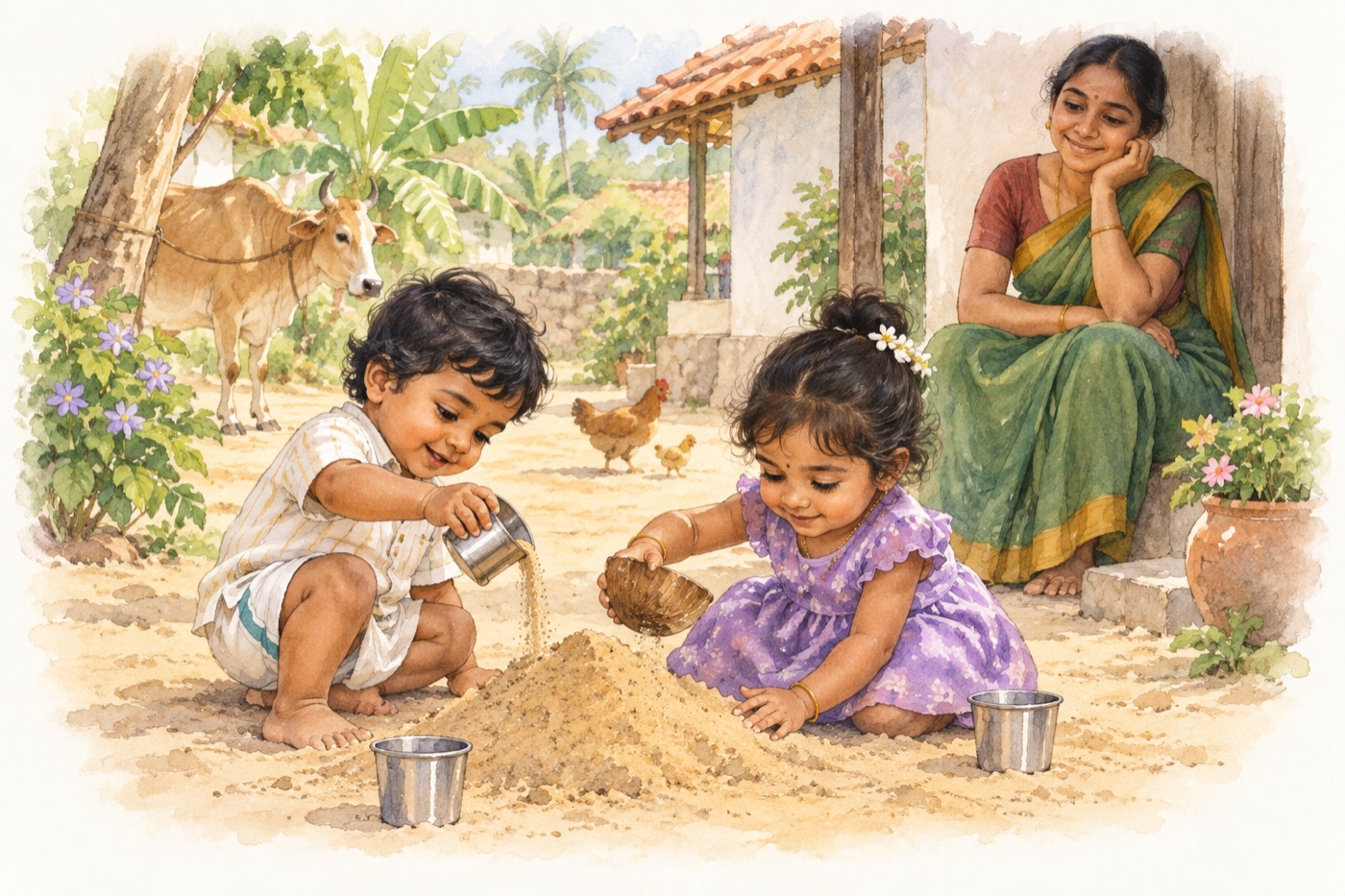
A mud kitchen for kindergarten is the cheapest and happiest corner a school can build, and I have believed this ever since a small boy served me rasam under a neem tree. It was the end of a training morning. The teachers were packing up their charts, and I walked out to the back of the campus where a few old vessels had been left near a tap.
A four-year-old was crouching there with a dented steel tumbler. He had mixed mud, water and a few crushed neem leaves. He stirred it with a twig, very seriously, and then held it up to me. "Rasam, Aunty. Hot. Blow first." I blew. He watched to see that I did it properly. Then he went back to make more, because his friend wanted some too.
What I saw in that one tumbler
That boy did not know he was learning. But in five minutes he had measured, mixed, waited, named, served and shared.
He knew rasam needs to be thin, so he added more water. He knew hot food must be blown on. He knew guests are served first. All of that came from his own home, his own amma's kitchen, and he was bringing it into school through his hands.
A child who cooks with mud is not making a mess. She is making sense of her world.
Why every kindergarten needs one
We spend a lot of money on plastic toys that do one thing. A mud kitchen does a hundred things, and it costs almost nothing.
Here is some of what happens there, every single day:
- Early maths – full, half, empty, more, less, heavy, light. Three spoons of sand, one cup of water.
- Language – children name what they cook, take orders, argue over recipes, and tell long stories about the wedding feast they are preparing.
- Science – mud that is too wet, sand that will not hold shape, leaves that float, seeds that sink.
- Friendship – one child cooks, one serves, one is the guest. They take turns without being told.
- Strong hands – pouring, scooping and squeezing build the small muscles a child needs before she holds a pencil.
- Calm – the feel of cool mud settles an anxious child faster than any lecture.
NEP 2020 and the NCF for the Foundational Stage both ask us to let children learn through play, through the senses and through their own culture. A mud kitchen does exactly that, without a single worksheet. I have written more on this in play-based learning in kindergarten.
How to build one this week
You do not need a contractor or a budget meeting. You need a corner and a little courage.
Choose the place
Pick a shaded spot near a tap or a water drum, ideally under a tree. A verandah edge or a strip of open ground works well. Make sure teachers can see it easily.
Collect the vessels
Ask parents. Every home has an old kadai, a dented tumbler, a cracked idli plate or a ladle nobody uses. Add:
- Steel and aluminium vessels of different sizes
- Coconut shells, old spoons, a sieve, a funnel
- A low wooden plank or a few bricks as the "stove" and counter
- Baskets of tamarind seeds, pebbles, dry leaves, flowers that have fallen
- A bucket of water and a mug
Avoid glass and sharp edges. Keep it simple; children will invent the rest.
Set a few easy rules
- Mud stays in the kitchen.
- We wash hands after cooking.
- We do not throw.
- Pack up together when the bell rings.
What about the clothes?
This is the first worry every parent and principal raises. It is fair. Keep a set of old shirts or aprons at school. Plan mud kitchen time before lunch or at the end of the day. And gently tell parents why it matters.
When parents see their child come home talking about the sambar she made for her whole class, most of them stop worrying about the stain. Some even start sending vessels.
The teacher's quiet role
Do not cook for them. Do not correct the recipe. Sit nearby, accept the tea when it is offered, and ask, "What did you put in this?" Listen. You will learn more about each child in ten minutes there than in a week of circle time.
If your team would like help with observing children in open play like this, our KG teacher training spends real time on it.
Begin small, begin now
Start with one corner and five vessels this month. Watch what the children do with it. Then come back to it with them, add, change, and let it grow.
When the children are ready to move from pretend cooking to real food, try our kindergarten salads. And if you would like Sarvam Ekam to walk through your campus and help you plan outdoor spaces like this, please write to me. Sarvam Ekam works with a group of schools and trains teachers on their own campuses, and I would be glad to sit with you under your tree too.
With warmth, Jayanthi
Questions parents and teachers ask
What is a mud kitchen in kindergarten?
A mud kitchen is an outdoor play corner with old vessels, water, mud, sand and natural materials where children pretend to cook. It supports maths, language, science and social skills through open-ended play.
How do I make a low-cost mud kitchen for school?
Choose a shaded spot near water, collect old steel vessels, coconut shells, spoons and a sieve from parents, and use bricks or a wooden plank as a counter. Add natural loose parts like tamarind seeds, pebbles and leaves.
Is mud play safe and hygienic for young children?
Yes, with simple care. Use clean soil from a known spot, avoid glass and sharp edges, supervise the corner, and make handwashing after play a fixed routine.
What age is a mud kitchen suitable for?
Children from around two years to the end of primary school enjoy mud kitchens. Younger children pour and scoop, while older ones invent recipes, stories and games together.
More Letters from the Founder →
Jayanthi Vijayan
Founder of Sarvam Ekam. Jayanthi works with kindergartens across India on audits, teacher training and curriculum design, bringing together Waldorf, Montessori, Reggio Emilia and traditional Indian play.
Connect on LinkedIn →