Nondi, Paandi and the Sangam Poets: What We Really Know
Is the Nondi game in Sangam literature? An honest look at Paandi's history, what the Sangam poems really say about children's play, and why it belongs in school.
 Jayanthi Vijayan
· 5 min read
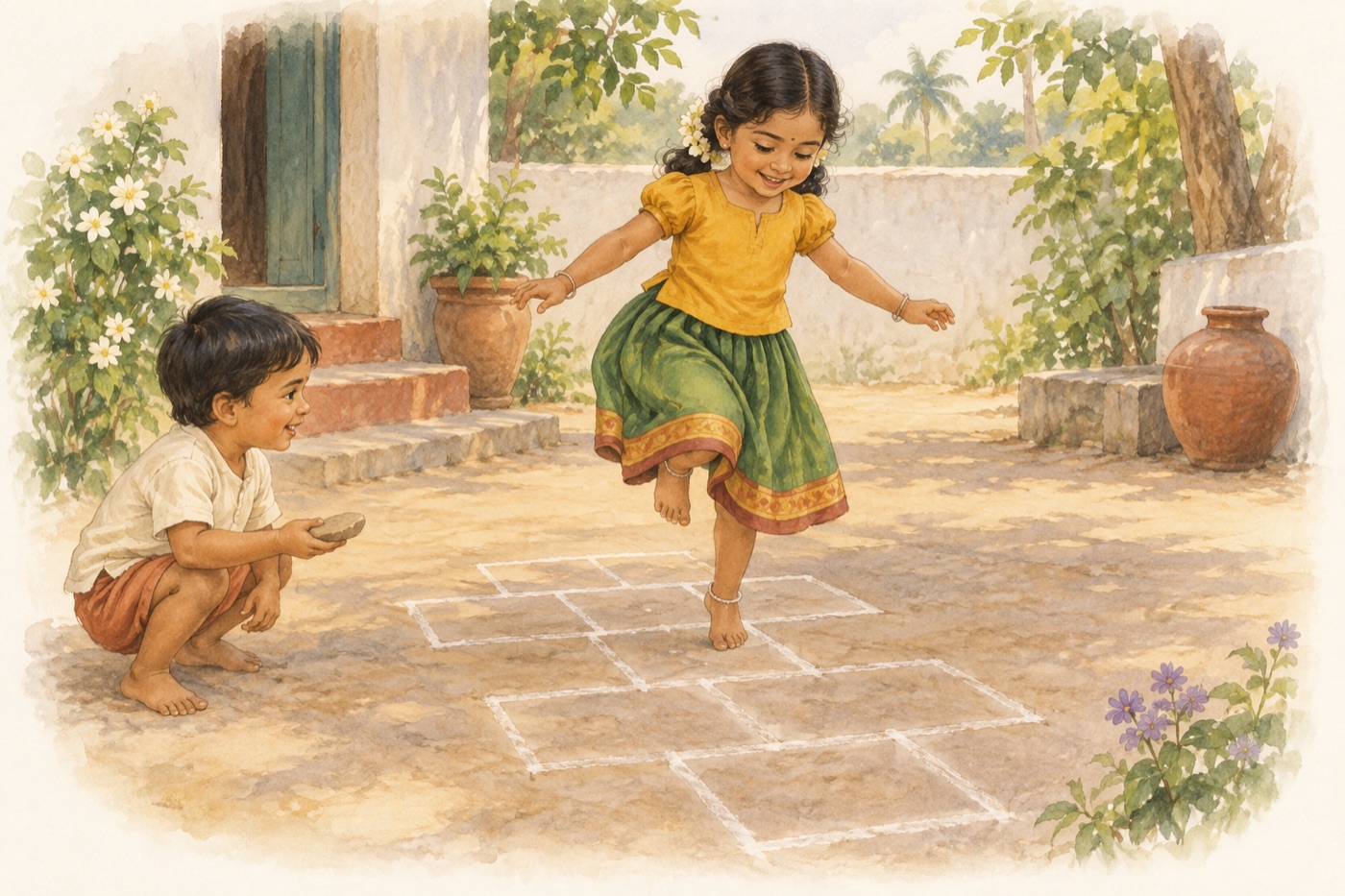
Ask any grandmother in Tamil Nadu about Nondi and she will smile before she answers. She will remember the chalk lines on the street, the flat stone in her palm, and the wobble of standing on one leg while everyone waited for her to fall.
Children call it Nondi, Paandi or Paandi-aattam. Most of the world knows it as hopscotch. In Karnataka it is Kunte Bille, in Andhra Pradesh and Telangana it is Tokkudu Billa, and in the north it is Stapu. One game, many names, and almost every Indian adult has played it.
Lately I have been asked a question about it, often with a forwarded message attached: Is it true that Nondi is mentioned in Sangam literature? This letter is my honest answer.
What the name tells us
Nondi (நொண்டி) comes from nondu, to limp or hop on one leg. The game is named after what the body does. The flat stone or tile shard is the sillu (சில்லு), and the drawn grid is the kattam (கட்டம்).
Paandi is harder. Some people link it to the old Tamil word paandil (பாண்டில்), which means something round and flat, like a disc. It is a lovely idea, because the sillu is exactly that. But I have not found a scholar or dictionary that confirms it, so please hold it as a guess, not a fact.
What Sangam poetry does say
Here is the honest part. I have not found a single Sangam poem that names Nondi or Paandi. Some websites say that ancient Tamil literature has several references to the game, but none of them give a poem number. Even Wikipedia's page on Paandi says its origin cannot be established, because it is a folk game.
That does not mean the poets ignored children at play. They wrote about it often, and beautifully.
Girls playing together
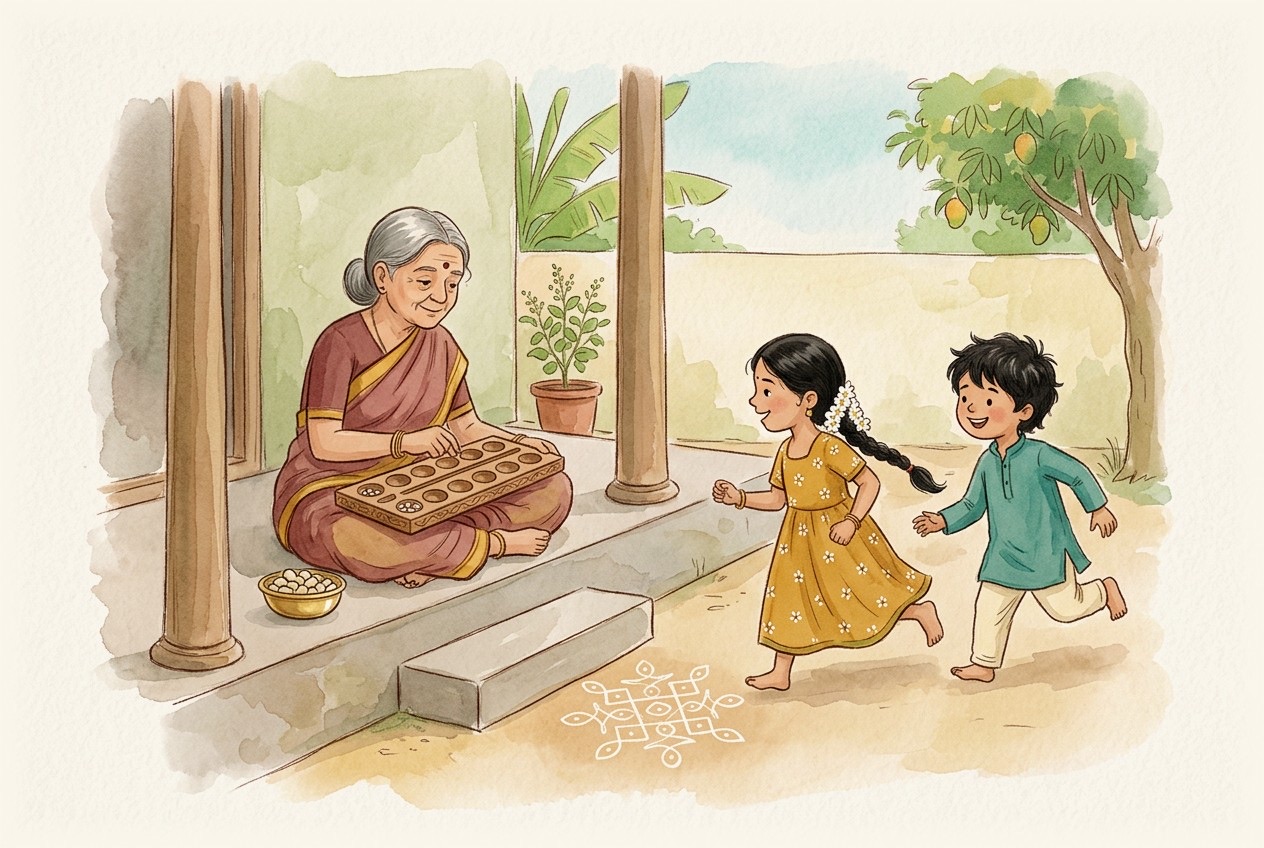
The anthologies keep using two words for a group of girls at play: aayam (ஆயம்) and orai (ஓரை). We meet them on the seashore, in the millet fields and on village streets. Play is shown as something children do together, outdoors, without adults running it.
Sand houses on the street
In Kalittokai 51, a young woman reminds her friend of a boy who used to run down their street and kick over the little sand houses (manal sitril) the girls had built. The poem is about love, but the picture inside it is of children playing on a street, building, and being interrupted. Scholars still argue about how to read this poem; you can see one comparison of its commentaries here (in Tamil).
A seed pressed into the sand
In Natrinai 172, a girl remembers playing with her friends on the white sand and pressing a punnai seed into it, then forgetting it. The seed grew into a tree, and her mother told her the tree was her sister. You can read this poem with a word-by-word translation on Vaidehi Herbert's Natrinai translations.
Other games we do find
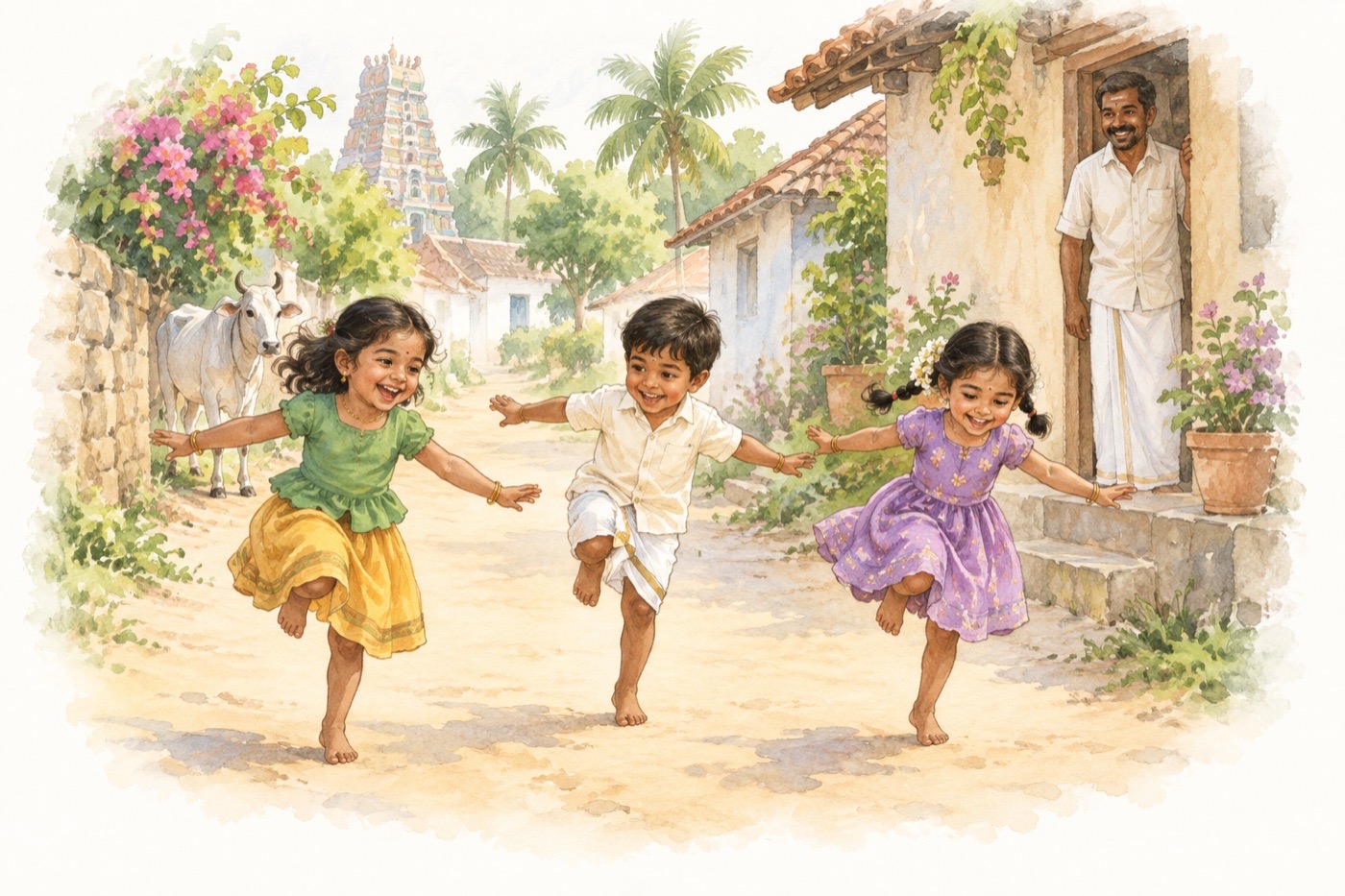
The poems also mention ball play (pandu), games with kazhangu seeds, swings (oosal) and water play (punal aadal). Two thousand years ago, Tamil children were throwing, catching, counting, swinging and splashing, much as they do now.
So where does Nondi come from?
Nondi belongs to a different kind of history. It was not written down. It was taught by one child to another, on a street, in a courtyard, after school. The detailed rules and the many grid shapes mostly appear in folklore collections from the last two centuries, and in our own memories.
You may also have read that hopscotch was invented to train Roman soldiers. There is no good evidence for that story either. Games like this seem to grow wherever there is flat ground, a stone and a group of children.
I find this more moving than a single line in an old poem would be. The Sangam poets show us children who already played in groups, in the open, on sand and street. Nondi is part of that same living tradition. It survived because children kept choosing it.
Why it still belongs in school
One round of Nondi asks a lot of a child:
- Balance and body sense. Standing and hopping on one leg, bending to pick up the stone without putting a foot down.
- Planning. Skipping the square where your own stone lies, and working out your path before you hop.
- Number. Counting squares, saying the sequence, knowing which number comes next.
- Aim. Throwing the sillu so it lands inside a square and not on the line.
- Fairness. Waiting your turn, and arguing honestly about whether a foot touched the line.
That is body, mind, number, self-control and language in a few minutes, for the cost of a piece of chalk. I wrote more about why games like this work in Traditional Games in Schools, and you can see where Nondi sits among other games, by age, on our traditional games page.
A small request
If you share Nondi with children or teachers, share it truthfully. We do not need to borrow authority from the Sangam poets for it. Nondi is old, it is ours, and it is still being played. That is enough.
And if you know a poem, a folk song or a grandmother's rhyme that mentions Nondi, please write to me. I would love to add it to this letter.
With warmth, Jayanthi
Questions parents and teachers ask
Is Nondi mentioned in Sangam literature?
No Sangam poem that names Nondi or Paandi has been identified. The Sangam anthologies do describe children's group play, such as girls building sand houses on the street in Kalittokai 51, and ball games, seed games, swings and water play.
What does the word Nondi mean?
Nondi comes from the Tamil nondu, to limp or hop on one leg, which is how the game is played. The flat stone is called the sillu and the grid is the kattam.
What are the other names for Nondi in India?
Paandi or Paandi-aattam in Tamil Nadu, Kunte Bille in Karnataka, Tokkudu Billa in Andhra Pradesh and Telangana, Stapu in the north, and hopscotch in English.
What skills does Nondi build in children?
Balance and body awareness, planning, counting and number sequence, aiming, turn-taking and fair play.
More Letters from the Founder →
Jayanthi Vijayan
Founder of Sarvam Ekam. Jayanthi works with kindergartens across India on audits, teacher training and curriculum design, bringing together Waldorf, Montessori, Reggio Emilia and traditional Indian play.
Connect on LinkedIn →