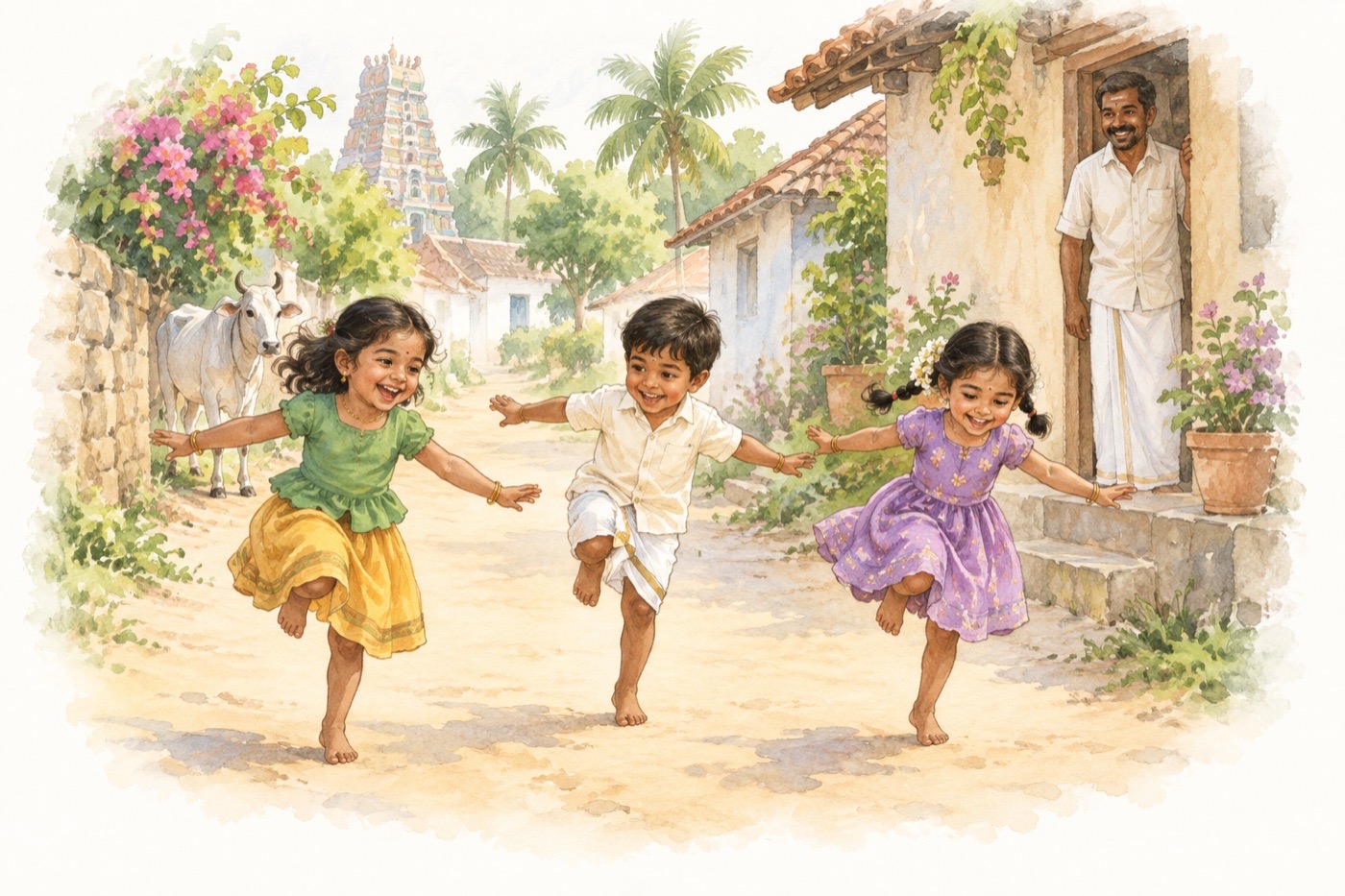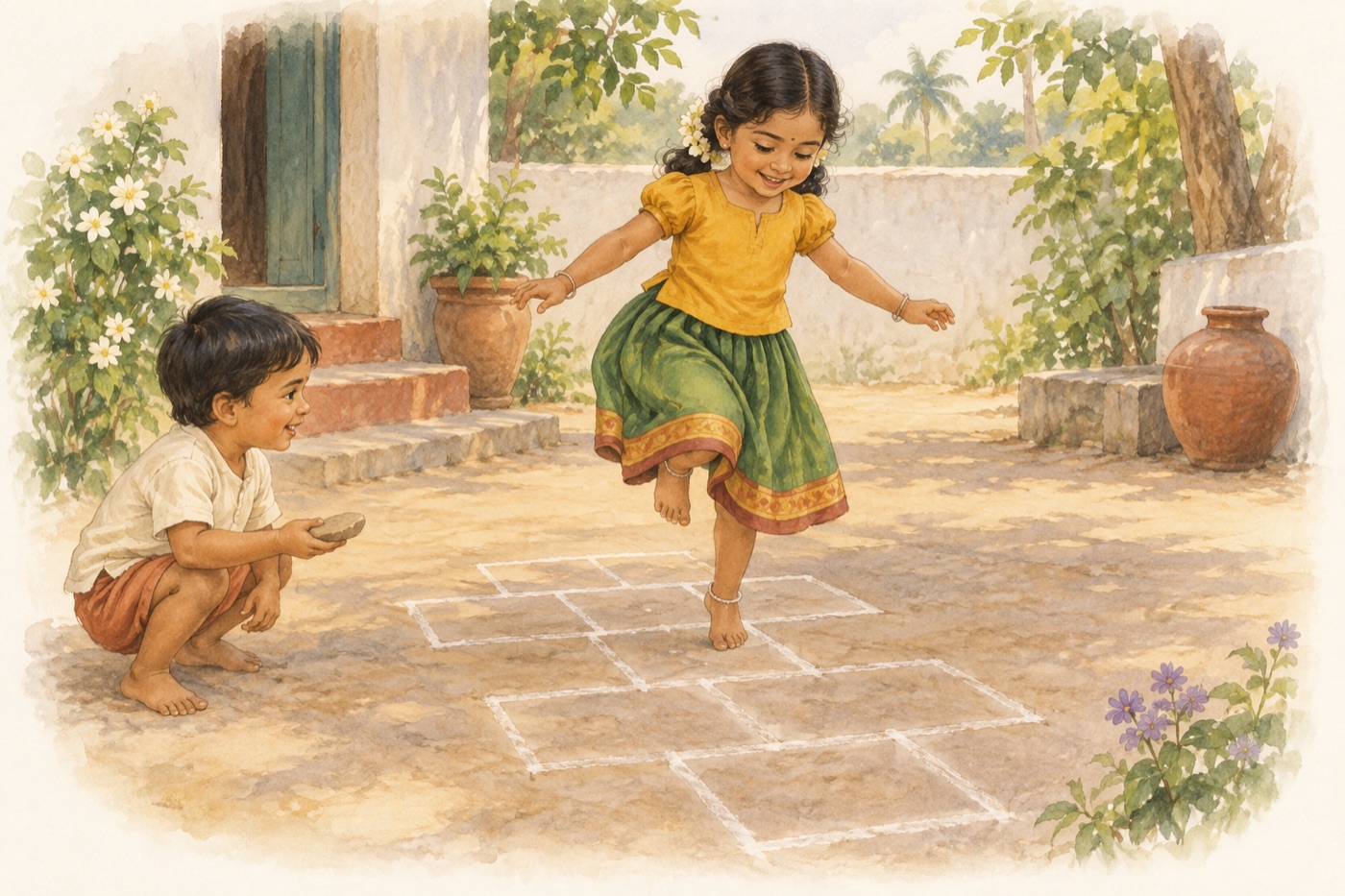
Pallankuzhi for Kids: How a Traditional Tamil Game Builds Early Maths
The pallankuzhi game for kids builds counting, planning and patience. How this traditional Tamil board game teaches early maths, and how to start.
 Jayanthi Vijayan
· 3 min read
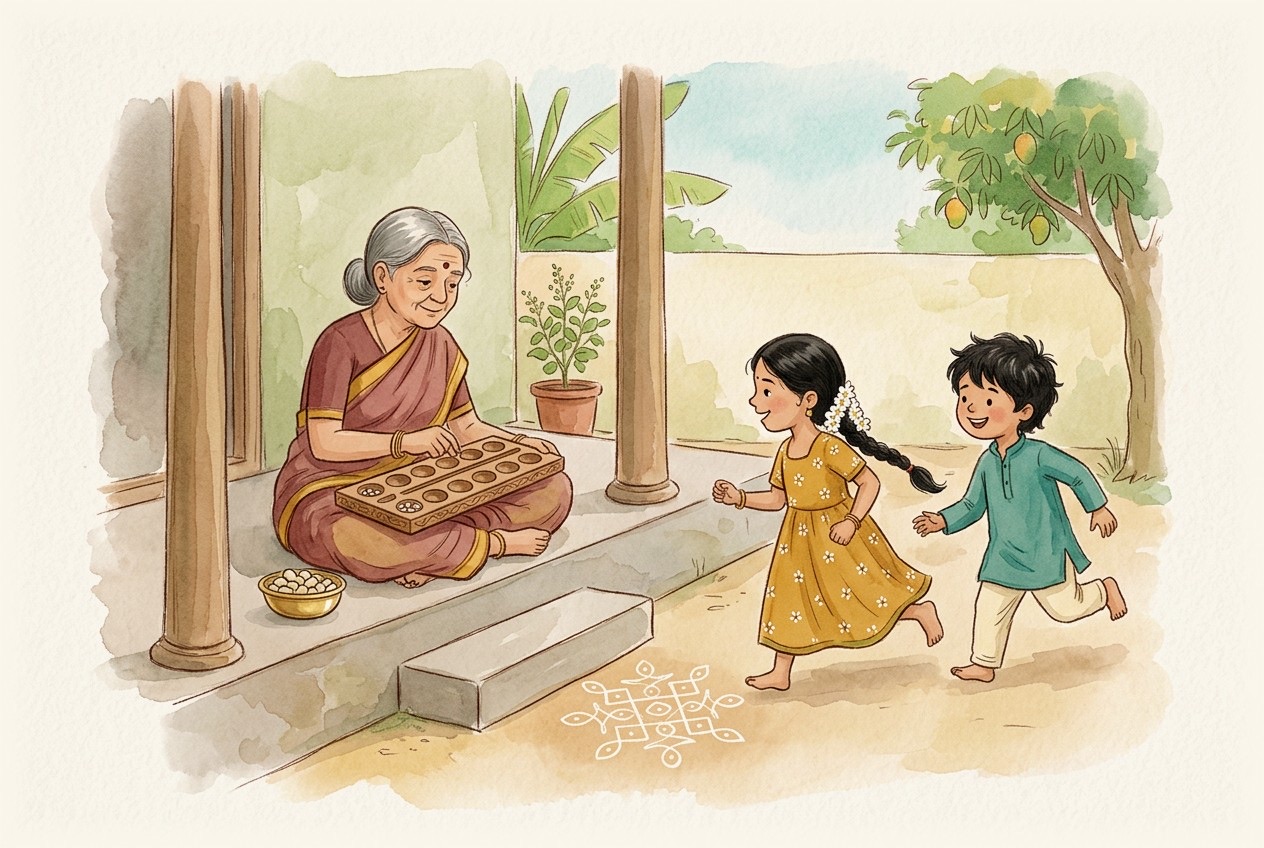
The pallankuzhi game for kids is one of the oldest maths lessons in South India, and it never felt like a lesson at all. A wooden board, fourteen pits, a handful of tamarind seeds or cowries, and two players. That is all it needs. Yet every turn asks a child to count, predict and plan.
At Sarvam Ekam we use pallankuzhi in kindergarten classrooms and teacher training because it does quietly what worksheets struggle to do: it makes numbers something you can hold in your hand.
What is pallankuzhi?
Pallankuzhi (பல்லாங்குழி) is a traditional mancala game played across Tamil Nadu and neighbouring states. The board has two rows of seven pits. Players pick up all the seeds from one pit and sow them, one by one, into the pits that follow. Where the last seed lands decides what happens next: keep sowing, capture seeds, or stop.
Rules change from family to family and village to village. That is part of its charm. You can read more about its history on Wikipedia's Pallanguzhi page.
How the pallankuzhi game for kids builds early maths
Every turn is a small maths problem, solved with the hands first and the head later.
- One-to-one counting. Dropping exactly one seed in each pit is the foundation of counting. Children feel the rhythm: one seed, one pit.
- Number sense. After a few games, children start to see that a pit holds "about six" without counting. This is called subitising, and it grows with play.
- Prediction. "If I pick up five seeds from here, where will the last one land?" This is early addition, done in the mind.
- Planning and strategy. Older children compare two or three possible moves before choosing. That is the beginning of logical thinking.
- Patience and turn-taking. Waiting while a friend sows, and accepting a capture with grace, builds self-control.
Start simple: four steps from sowing to strategy
We do not hand a three-year-old the full traditional game. In our Pallankuzhi book we build up in four stages:
- Sowing Seeds (ages 3+): only sowing, no capturing. The joy is in the dropping.
- Catch the Pasu: a pit that reaches four seeds becomes a "pasu" (cow) and is captured.
- Jump the Empty Pit: children learn that an empty pit changes what happens next.
- The full game: relay sowing, captures and rounds, as grandparents played it.
Each stage adds one new rule, so children stay successful while the thinking gets deeper.
Bringing pallankuzhi into the classroom
You do not need a carved wooden board. Chalk circles on the floor and a basket of seeds work beautifully, and a whole group can gather round. A few ideas teachers use:
- Play the sowing stage as a whole class, with one child walking and dropping seeds into chalk pits.
- Ask "Where will it land?" before every move, and let children check by sowing.
- Count each pit together at the end and compare: more, fewer, the same.
- Link it to a story about the family or village where the game came from.
When children play pallankuzhi, the numbers are never on a page. They are in their palms.
Play it online, then on the floor
If you do not have a board yet, children can try all four games on our free online Pallankuzhi game, against the computer or a friend. We still recommend the real board as soon as possible: the weight and sound of the seeds matter.
For more games like this, see our guide to traditional games by age, or try Aadu Puli, the goats-and-tigers strategy game.
Want this in your school?
Traditional games are part of our kindergarten teacher training. We show teachers how to run them, what to observe, and how to link them to the maths goals of the foundational stage. Get in touch to bring it to your classrooms.
Questions parents and teachers ask
What age can children start playing pallankuzhi?
Children as young as three can enjoy the simple sowing stage, dropping one seed in each pit. The full traditional game with captures suits most children from about six or seven.
What maths skills does pallankuzhi teach?
It builds one-to-one counting, number sense, early addition through predicting where the last seed lands, and planning and strategy as children compare moves.
Do I need a wooden board to play pallankuzhi?
No. Fourteen chalk circles on the floor, or small bowls in two rows, work well. Seeds, tamarind seeds, shells or pebbles can be the counters.
More Letters from the Founder →
Jayanthi Vijayan
Founder of Sarvam Ekam. Jayanthi works with kindergartens across India on audits, teacher training and curriculum design, bringing together Waldorf, Montessori, Reggio Emilia and traditional Indian play.
Connect on LinkedIn →