The Game My Grandmother Taught Me: Traditional Games and Critical Thinking, From Three to Eighty
How traditional games for critical thinking pass knowledge from grandparent to child, and why Aadu Puli and Pallankuzhi still challenge players at 21 and beyond.
 Jayanthi Vijayan
· 7 min read
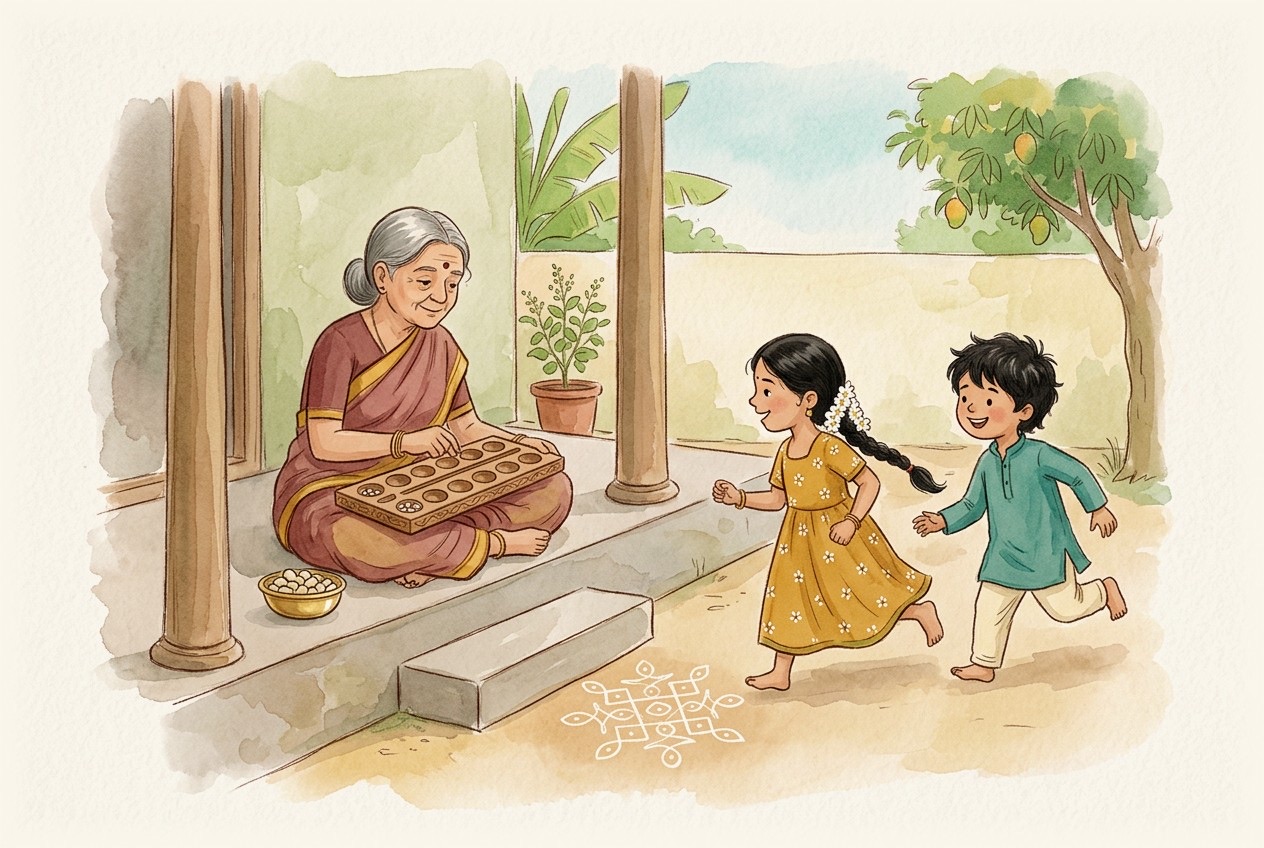
For a long time I thought of traditional games for critical thinking as something we had to bring back into schools. Then a grandmother on a school verandah showed me I had it the wrong way round. The games never left. They were waiting in the hands of the people who had played them all their lives.
This letter is about what those hands carry. I want to talk about how knowledge travels from one generation to the next through ordinary, everyday play. And I want to talk about why these games keep working when the child is no longer a child: at 21, at 45, at 80.
A grandmother, a chalk board and fifteen goats
It was a grandparents' morning at one of the schools we work with. Sarvam Ekam works with a group of schools and trains teachers on their own campuses, so I am often there for days like this.
One paati had come in a cotton saree, carrying a small cloth bundle. She sat down on the verandah floor, untied it, and took out tamarind seeds and three smooth pebbles. With a piece of chalk she drew the Aadu Puli board, the triangle with its lines, quickly and without measuring. She had clearly drawn it hundreds of times.
Four children from the senior KG class squatted around her. She did not explain the rules first. She just said, "I am the tiger. You are the goats. Don't let me eat you."
Within a few minutes, a boy called Karthik stopped moving. He held a seed above the board and did not put it down. "If I go here, she will jump," he said, mostly to himself. Then he moved a different goat to block the gap instead.
Paati smiled and said nothing. She did not praise him. She simply made her next move, a harder one.
The young teacher standing next to me whispered, "I played this with my thatha in the summer holidays. I had forgotten." By the end of the morning she was sitting on the floor too, playing tiger against two of her own students, and losing.
How knowledge travels without a textbook
Nobody wrote a lesson plan for that morning. Still, a great deal was taught.
When a grandmother plays with a grandchild, she passes on much more than the rules:
- How to wait. Your turn comes, and then it passes.
- How to look ahead. You learn to say "if I do this, then she will do that."
- How to count without being asked to count. Seeds in pits, goats left on the board, steps to the next ladder.
- How to lose and sit down again. No sulking, because the next round is starting.
- How to talk while thinking. Most of these games are played with someone close by, so there is always talk and teasing and a bit of a story.
This is how it worked in our homes for a very long time. Afternoons after lunch, festival holidays, rainy days when nobody could go out. An athai taught Pallankuzhi. An older cousin taught goli and pambaram on the street. Nobody called it education, but it was.
NEP 2020 and the NCF for the Foundational Stage both talk about play and about learning that is rooted in the child's own culture and surroundings. Our traditional games are exactly that, and they were already sitting in the cloth bundle.
What thinking actually happens inside a game
"Critical thinking" can sound like a big word for a five-year-old. But look closely at what a child does during a game.
Reading the board
Before moving, the child has to notice where everything is. Which pit has the most seeds? Which goat is unguarded? Every turn starts with this kind of looking.
Holding a rule in the mind
In Aadu Puli the tiger can jump but the goats cannot. In Paramapadham the snake always takes you down, even when it isn't fair. The child keeps the rule in mind and makes their moves inside it. That is reasoning.
Predicting
"If I sow from this pit, my last seed lands there." This is the start of planning. Karthik with his seed in the air was doing exactly this.
Changing the plan
The other player does something unexpected. The child has to drop the plan and make a new one. That kind of flexible thinking is hard to teach on a worksheet.
Questioning the rule itself
Older children start asking, "What if the tiger can only jump twice?" When a child invents a fairer rule, they are thinking about the system as well as the move.
A game is a small world with clear rules. Inside it, a child is free to think as hard as she likes, and nobody tells her she is wrong. The board does that.
The same game, from three to eighty
This is the part I find most beautiful. These games grow with the player. Nothing has to be redesigned. The board stays the same while the thinking gets deeper.
Take Pallankuzhi or Aadu Puli:
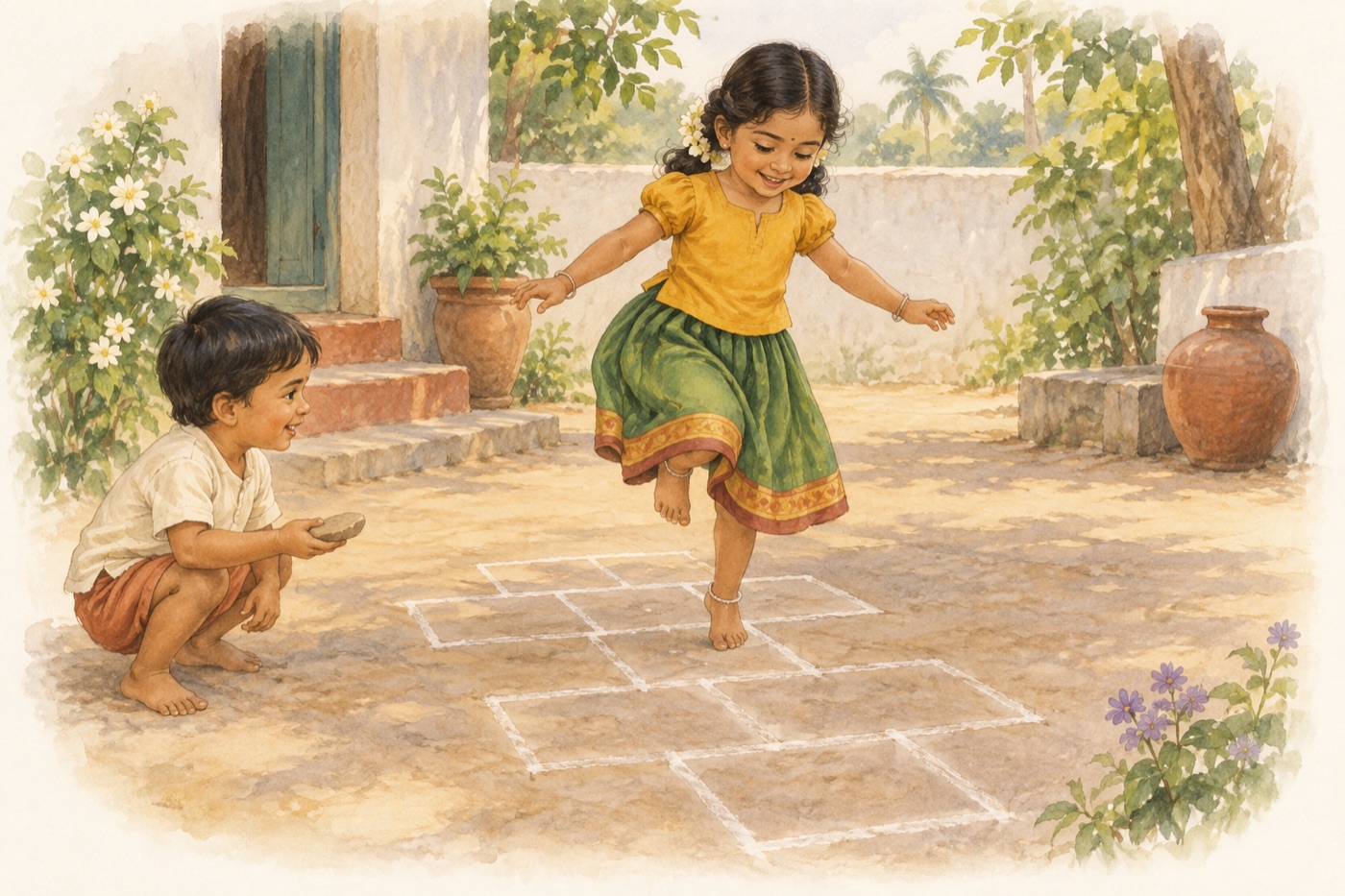
- Ages 3 to 5. The child handles the seeds, drops one into each pit, counts aloud and enjoys the sound. Taking turns is the whole lesson.
- Ages 6 to 9. Rules are followed properly. The child starts to notice patterns, like "this pit always gives me a lot."
- Ages 10 to 14. Strategy starts. The child plans two or three moves ahead and begins to read the opponent.
- Ages 15 to 21. Players argue about the best opening, try out variations and teach younger ones. Teaching a game is a test of whether you really understand it.
- Beyond 21. Adults play for the pleasure of a good opponent. Elders play to keep the mind sharp and for company. I have watched grandfathers bent over a Thaayam board during the Pongal holidays, as fierce as any ten-year-old.
We have put together a list of traditional games by age, from 0 to 21 for teachers and parents who want a place to start. Please treat 21 as a door that stays open, though.
Why adults should play too
When I speak to teachers, I often hear, "These are for the children." I gently disagree.
When a teacher plays, three things happen. The children see an adult who is willing to think, lose and try again. The teacher remembers her own childhood, and that memory changes how she talks to children. And the teacher gets to watch thinking happen in real time, which no test paper will ever show her.
It is the same for parents. A father who sits down for one round of Aadu Puli after dinner, with the phone kept away, is passing something on. It isn't only the game. He is showing the child that thinking together is a good way to spend an evening.
You can try Aadu Puli online to remember the rules. Then I hope you will draw it with chalk on the floor, because that is where it belongs.
What you can do this week
You don't need a budget, a new room or a training programme to begin.
- Invite one elder. Ask a grandparent, a school ayah or the watchman to teach one game they played as a child. Let them teach it their own way.
- Keep a game corner. Put a cloth bag of tamarind seeds, a Pallankuzhi board, chalk and a few pebbles in one place where children can reach them.
- Watch before you teach. Spend ten minutes observing children play and write down one moment where you see them thinking.
- Play at home. Parents, choose one evening a week for a board game on the floor with the whole family. Mix the ages.
- Let older students teach. Class 8 can teach UKG. Both groups will learn something.
- Ask, "What if?" Once children know a game well, invite them to change one rule and see what happens.
If you want a fuller picture of how to bring these games into a school timetable, my earlier letter on traditional games in schools goes into that.
Pass it on
That paati went home with her cloth bundle, but the game stayed behind. The young teacher now plays Aadu Puli with her class every Friday. Last month Karthik taught it to his little sister.
That is how it has always worked, one person sitting down beside another on a floor.
If you would like help building traditional play into your school, for children and teachers alike, please write to me. And if you have a game your grandmother taught you, I would love to hear about it.
With warmth, Jayanthi
Questions parents and teachers ask
Which traditional Indian games help children with critical thinking?
Strategy games like Aadu Puli Aattam (Goats and Tigers), Pallankuzhi, Thaayam and Paramapadham all ask children to read a board, keep rules in mind, predict moves and change plans. Physical games like Kho-kho and Kabaddi also involve quick decisions and teamwork.
At what age can children start playing Pallankuzhi or Aadu Puli?
Children of three or four can enjoy handling the seeds, counting and taking turns. Proper strategy usually shows up from around six or seven. Teenagers and adults keep finding new depth in the same game.
Are traditional games useful for adults and teenagers too?
Yes. The board stays the same and the thinking gets deeper, so older players plan further ahead, try variations and teach younger players. Many elders play these games for company and to keep the mind active.
How can a school start using traditional games without extra cost?
Invite a grandparent or staff member to teach a game they played as a child, and keep a corner with tamarind seeds, chalk, pebbles and a Pallankuzhi board. Make time for play every week and let older students teach the younger ones.
More Letters from the Founder →
Jayanthi Vijayan
Founder of Sarvam Ekam. Jayanthi works with kindergartens across India on audits, teacher training and curriculum design, bringing together Waldorf, Montessori, Reggio Emilia and traditional Indian play.
Connect on LinkedIn →